

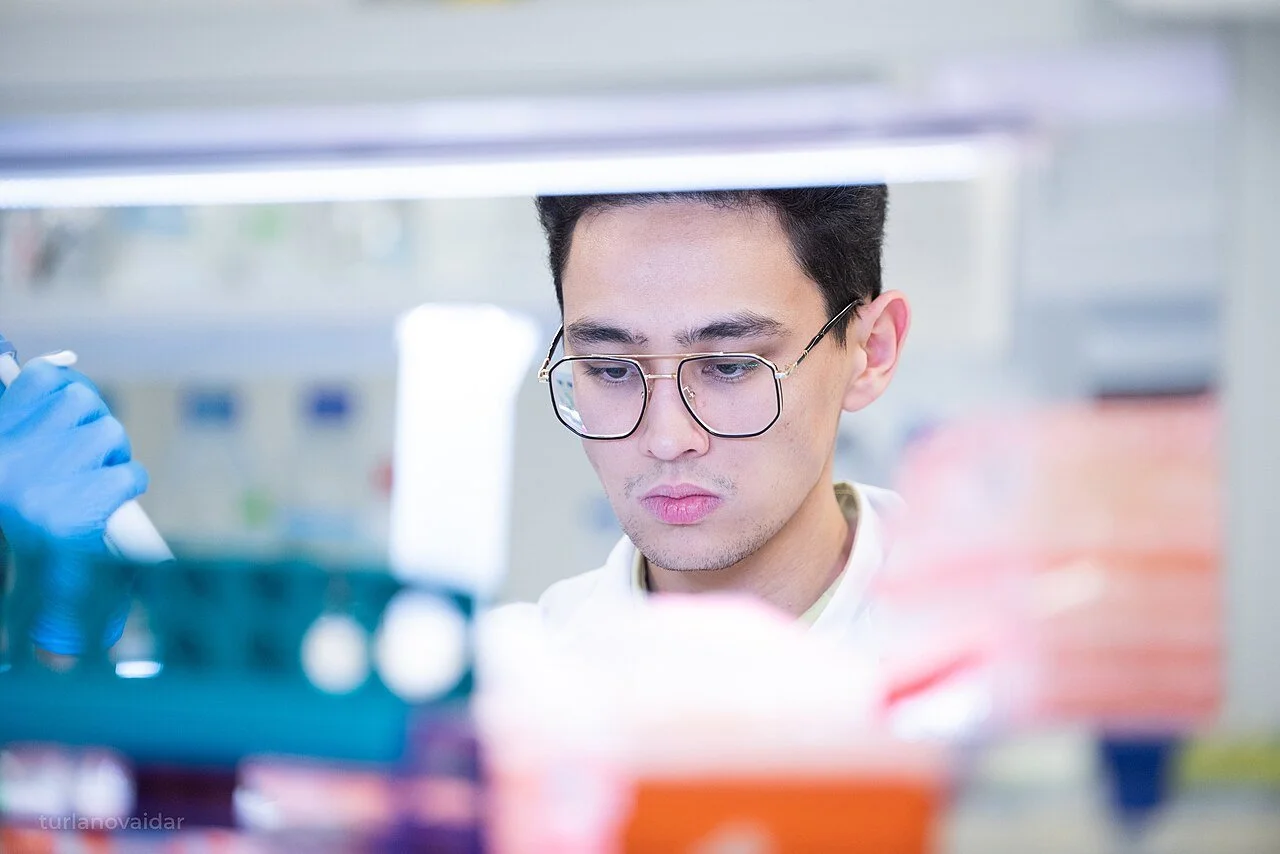
Photo: Aidar Turlanov, CC BY 4.0, via Wikimedia Commons.
Updated November 2026
TL;DR: BU RISE, Boston University's Research in Science & Engineering program, is a six-week summer research program in Boston. It's open to high school juniors who are US citizens or permanent residents. For summer 2027, you'll need to apply by Feb 3, 2027. BU RISE is very selective, and we estimate that about 1 in 10 applicants or fewer get in.
If you're a junior who enjoys science, you might wonder what research looks like day to day. BU RISE gives you six weeks of full-time research at Boston University, ending with a poster you present to the public. It's one of several research programs for high school students in Massachusetts.
What is BU RISE?
BU RISE is a six-week summer research program at Boston University for high school juniors interested in science and engineering. BU RISE students choose one of two tracks, the Internship in a BU lab or the Practicum, a structured research course. Interns join a BU lab full-time. Practicum students learn from a BU instructor and do research as a group.
BU RISE Internship vs. Practicum: which track fits?
The BU RISE Internship fits students who already know their field, and the Practicum fits students who'd like more structure. As an intern, you'll work with a mentor. Your mentor might be a faculty member, a graduate student, or a postdoctoral fellow (a researcher who recently finished a PhD). Your mentor designs the project. You can choose from 15 research areas, such as astronomy, computer science, and public health (Internship Track). Practicum students start each day with a two-hour lecture and spend afternoons on group research. In 2026, the two Practicum subjects were Computational Neurobiology and Data Science. BU will announce the 2027 subjects in December (Practicum Track).
Here's a quick test. If you can name three BU professors you'd like to work with, the BU RISE Internship is a good first choice. If not, or if a computational subject sounds exciting, put the Practicum first. BU makes most Practicum offers to students who ranked it first. You'll only get an Internship offer once a professor agrees to host you (Admissions Timeline).
Who can apply to BU RISE, and what are the key dates?
You can apply to BU RISE if you're a high school junior and a US citizen or legal permanent resident. That means you'll be starting your senior year in fall 2027 (RISE FAQ). BU RISE is closed to international students, but you can find other options in these summer research programs for international students. BU says competitive applicants usually have an unweighted GPA in the A- to A range (How to Apply).
BU RISE applications open in mid-December and close in early February, with recommendations due the same day. You can check each cycle's dates on the Admissions Timeline page. Here are the key facts for summer 2027:
Applications open: Dec 15, 2026.
Deadline: Feb 3, 2027, at 11:59 pm Eastern, for both your application and your recommendation.
Program dates: Residential students move in on June 27, 2027, and commuters start June 28. The program ends Aug 6, and BU says these dates are still pending approval (Calendar).
Tests: Test scores are optional for 2027.
How much does BU RISE cost?
At 2026 prices, BU RISE costs $10,735 for residential students and $6,415 for commuters. BU RISE is a big expense, and commuting from home is much cheaper than living on campus. The residential price covers tuition, housing, 19 meals a week, and all fees. BU currently lists a $75 application fee. BU will post 2027 prices on Dec 15 (Tuition, Aid & Payment).
BU RISE offers limited need-based financial aid, and your aid request is due with your application. To ask for aid, you'll answer yes to the aid question on your application. Then you'll upload pages 1 and 2 of a parent's tax return. You'll also add a parent's letter about your finances. BU decides on admission without looking at aid requests.
How selective is BU RISE?
In our view, BU RISE is very selective, with an estimated acceptance rate of about 10% or lower. BU doesn't publish an acceptance rate. It also says that about 190 students attended in 2026, out of thousands of applicants (RISE FAQ). Even if only 2,000 students applied, 190 places would be fewer than 1 in 10, so the real acceptance rate could be lower still.
What do BU RISE students do?
BU RISE students spend most of each weekday on research and have evenings free to explore Boston. Interns work in the lab from about 9 am to 5 pm. Once a week, you'll join workshops on topics like research ethics, reading a paper, and making a poster. Past RISE groups have also gone to a Red Sox game, taken a Boston Duck Tour, and visited the New England Aquarium together (Calendar).
Every BU RISE student writes an abstract and presents a poster at the Poster Symposium on the program's last day. In 2025, one biology intern studied how fire and forest edges affect trees in oak woodlands. A neuroscience intern looked at dopamine neurons in fruit flies. A Data Science Practicum group tested machine learning models for forecasting Boston's MBTA transit system (Poster Symposium).
Pros and cons of BU RISE
BU RISE gives you real university research with expert mentors, but it costs a lot and is hard to get into.
Pros:
Real lab work: Interns do about 40 hours a week of research with a BU mentor.
Many fields: The Internship covers 15 research areas, from astronomy to public health.
A finished product: Every student writes an abstract and presents a poster at the Poster Symposium.
Research skills: Weekly workshops cover research ethics, reading a paper, and making a poster, and Practicum students visit Boston biotech companies.
Cons:
High cost: Living on campus costs $10,735 at 2026 prices, and only limited aid is available.
Long odds: About 190 students attended in 2026, out of thousands of applicants.
Narrow eligibility: Only juniors who are US citizens or permanent residents can apply.
No college credit: RISE doesn't count for college credit, but you do get a certificate of completion.
Is BU RISE worth it?
In our view, BU RISE is worth applying to if you're an eligible junior who's curious about full-time research. Few high schoolers get to spend six weeks in a university lab with a mentor. It's a strong fit if you're drawn to one field and ready for long, focused days.
BU RISE is a weaker fit if the full cost would stretch your family or you want to choose your own research question. BU RISE interns work on projects their mentors design, and Practicum students work on group projects. If you're a sophomore, you're a year early for RISE, so you can plan ahead with these summer research programs for high school students.
How to apply to BU RISE
A strong BU RISE application connects your past work to the field and research you want to pursue at BU. Here are 6 tips to get there.
Pick your track first. Internship applicants write an extra essay of up to 250 words about three BU professors. If that's your first choice, give yourself extra time.
Find three professors in December. The Internship page links to each department's faculty list. Read a few lab websites, then pick three professors whose questions connect to something you've studied or built. BU can't promise you a spot in those labs.
Ask for your recommendation before winter break. Choose a STEM teacher, counselor, or research supervisor who has worked with you for at least six months. Tutors and coaches don't count. BU emails your recommender a short form to fill out.
Give each essay its own job. You'll write three essays. The first covers why you chose your subject (up to 300 words). The others cover your academic achievements (up to 250) and why you want to attend RISE (up to 200). Use a different story in each one.
Show what you did, with details. Describe a real class project, science fair entry, or coding project. Say what you did yourself, which tools you used, and what you tried when something didn't work.
Gather your documents early. You'll need a transcript from 9th grade through your fall 2026 grades, and an unofficial copy is fine. Aim to submit a few days before Feb 3.
If the BU RISE research projects sound interesting, you can try one of your own in AI. Once you know basic Python, you can design and run your own AI research project in the AI Fellowship at Veritas AI. You and your mentor will work together one-on-one for 15 sessions, sharpening your question and testing your ideas. Next, you'll work with a publication specialist for 4 sessions to turn your results into a paper for a journal or competition.
FAQs
When do BU RISE decisions come out?
BU says decisions come about 6 to 8 weeks after the deadline, so mid to late March 2027. BU sends Internship offers one at a time, as professors agree to host students. If you're admitted, you'll have one week to accept and pay a deposit (Admissions Timeline).
Do you get college credit for BU RISE?
No, RISE is a noncredit program. You'll get a certificate of completion, and Practicum students also get an evaluation letter from their instructor (RISE FAQ).
Do BU RISE students live on campus?
Most do, in a BU dorm shared with two other BU summer programs. You can also commute from a relative's home. Residential students need to be back by 11 pm Sunday to Thursday and by midnight on weekends.
Can you enter the Regeneron Science Talent Search with your BU RISE project?
Yes, you can. BU says some interns enter their RISE projects in national science contests, such as the Regeneron Science Talent Search (STS) (Internship Track).
Do you need research experience to get into BU RISE?
No, BU doesn't list research experience as a requirement. If you're a year away and want a first project for your essays, you can start with AI Scholars at Veritas AI. You don't need any coding experience, and each mentor teaches just five students in live classes. You'll team up with 3 or 4 classmates to build an AI project of your own.
Sources
You can check the details for your year on Boston University's own RISE pages.
Internship Track: research areas, mentors, and faculty lists.
Practicum Track: subjects, the daily schedule, and site visits.
How to Apply: eligibility, essays, and the recommendation.
Admissions Timeline: this cycle's deadline and how offers work.
Tuition, Aid & Payment: costs and how to apply for aid.
RISE FAQ: housing, credit, and more.
Start Your Own AI Research With Veritas AI
If a summer in a BU lab sounds exciting, you can start your own AI research well before then with Veritas AI. Students in more than 160 countries have taken its programs, over 3,200 in all. With Veritas AI, you can work with a mentor on an AI research question you choose yourself. Some of its 200+ mentors are researchers at Anthropic, Meta, and NVIDIA. Veritas AI internal data shows that 79% of the papers its students submitted have been published. You can see how Veritas AI's programs compare and choose the one that matches your experience so far.
About the author: Diya Tripathi leads operations at Veritas AI and studied computer science at Ashoka University.