
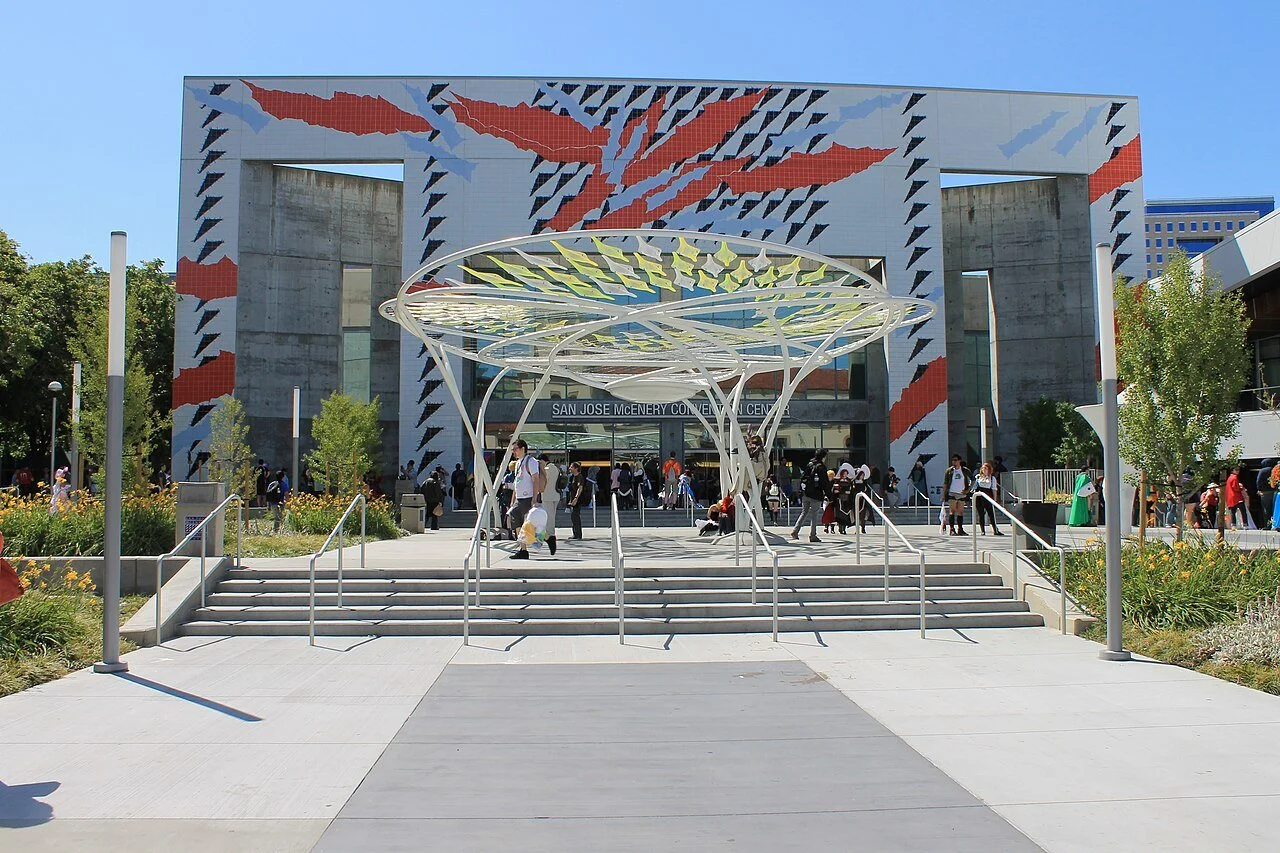
Photo: Michael Ocampo, CC BY 2.0, via Wikimedia Commons.
Updated November 2026
TL;DR: Thinking about a science fair project in Santa Clara County? The Synopsys science fair, called the Synopsys Championship on its website, is the county's yearly fair for grades 6 to 12. Its organizers have announced a new name, the Silicon Valley STEM Championship, so you may see either one. We estimate that about 1 in 100 Synopsys Championship entrants go on to the Regeneron International Science and Engineering Fair (ISEF), which is only for high schoolers. If your project doesn't need pre-approval, you can apply until Jan 8, 2027.
If you like to experiment, build, or code, the Synopsys science fair is a great place to show what you can do. You'll stand by your own project board and explain your work to real scientists and engineers. Your result at the Synopsys Championship depends mostly on three things you control: a clear question, careful testing, and how well you explain your work to the judges.
What is the Synopsys science fair?
The Synopsys science fair is the Synopsys Championship, Santa Clara County's yearly science and engineering fair for students in grades 6 to 12. A nonprofit called the Santa Clara Valley Science and Engineering Fair Association (SCVSEFA) runs it. The name comes from the Synopsys Outreach Foundation, the fair's title sponsor for 25 years. In 2026, SCVSEFA said Synopsys would be ending that sponsorship and announced a new name, the Silicon Valley STEM Championship (2026 newsletter). For the 2027 fair, SCVSEFA's website still says Synopsys Championship, so you may see either name for the same fair.
You compete in one of two divisions, Junior for grades 6 to 8 and Senior for grades 9 to 12 (About the Synopsys Championship). Projects go into categories like Computer Science, Biology, Chemistry, Environmental Science, and Medicine and Health. Top Synopsys Championship projects can go on to the California Science and Engineering Fair in April and to ISEF in May. ISEF brings together high school researchers from around the world, and selected Grand Prize winners go on an all-expenses-paid trip.
Who can enter the Synopsys Championship, and what are the key dates?
You can enter the Synopsys Championship if you're in grades 6 to 12 and go to school in Santa Clara County. Homeschoolers whose home school is in the county can enter, and so can county residents at a full-time online school. You also need to be younger than 20 on March 1 before the fair. You can only work on one project, either alone or on a team of 2 or 3 students. You can't enter another ISEF-affiliated fair in the same school year (Eligibility and Rules).
Synopsys Championship applications usually open in late September, most new projects are due in early January, and the fair itself is in early March in San Jose. Projects that need approval before you start experimenting are due earlier, in mid-November. Projects with human participants or hazardous chemicals need pre-approval. So does any student who has entered this fair, or another ISEF-affiliated fair, in an earlier year, even with a new project. You can find each year's dates on the Important Dates page. Here are the key facts for the 2027 Championship, as of November 2026:
Final deadline: Jan 8, 2027, at 11:59 pm, for new participants whose projects don't need pre-approval.
Pre-approval deadline: Nov 13, 2026, for projects that needed review before starting, including all returning participants. This deadline has passed.
Abstract upload: Feb 20, 2027, by 8 pm. SCVSEFA withdraws projects without an abstract.
Fair dates: Check-in is Mar 3, 2027, and judging is Mar 4, 2027, in South Hall at the San Jose McEnery Convention Center (Judging Day).
Cost: $40 for an individual project or $50 for a team.
Research window: Your work has to happen between Jan 1, 2026, and March 2027, and take no more than 12 months.
How hard is it to win at the Synopsys Championship?
Anyone eligible can enter the Synopsys Championship, but a Grand Prize is hard to win. In 2026, more than 1,000 students took part, and 11 Grand Prize winners qualified for ISEF. SCVSEFA also sent 12 students to ISEF in each of the two years before, so we estimate that about 1 in 100 Synopsys Championship entrants go on to ISEF (2025 newsletter, 2026 newsletter, 2026 winners). ISEF is only for students in grades 9 to 12, so middle schoolers can't qualify for it and compete for Junior division awards instead. Since the 1,000+ entrants include middle schoolers, a high schooler's odds are a bit better than 1 in 100. You also need to win a category award first to be considered for the state fair or ISEF (Judging FAQ). Those who make it often do well. At ISEF 2026, Championship students won a first place in Materials Science, plus awards in Mathematics, Animal Sciences, Biomedical Engineering, and Physics and Astronomy (2026 ISEF awards).
How is the Synopsys Championship judged?
Category judges score each Synopsys Championship project out of 40 points, with 10 points for each of four areas (Judging Criteria). Here's what judges look for in each area.
Scientific Thought or Engineering Goal: You state a clear question or design goal and control your variables. You also read enough background and draw conclusions that match your data. Software projects usually fit the engineering goal, which asks for testing, redesign, and retesting.
Creativity: Judges reward an original topic or approach. Ideas from the internet are allowed if you credit them, but they score lower.
Independent Work and Skill: Judges check how much of the work you did yourself and whether you understand it well for your grade. You need to credit any mentor who helped.
Thoroughness and Clarity: Judges look for repeated tests and clear data on your board and abstract. High schoolers also need a project notebook.
On judging day, you'll stand by your board and talk with judges one at a time. At least two category judges interview each Synopsys Championship project, and each talk starts with your one- to two-minute summary, with no slides. Then the judge asks questions, and the whole interview lasts up to 8 to 10 minutes. Parents and mentors can't come into the hall during judging. Judges can disqualify a project from awards if they see an adult coaching the student.
Pros and cons of entering the Synopsys Championship
The Synopsys Championship is cheap to enter and gives real feedback, but it takes months of planning and the ISEF spots are rare. We based these on SCVSEFA's own pages.
Pros:
Low cost: $40 for an individual project or $50 for a team.
Real feedback: At least two category judges interview each project, so you practice explaining your work to experts.
Many ways to win something: SCVSEFA gives First Place, Second Place, and Honorable Mention in both divisions, and about 34 organizations gave their own awards in 2025.
A path further: Top projects can go on to the California Science and Engineering Fair and to ISEF.
Cons:
Only for Santa Clara County: Students need to go to school in the county, or live there and attend a full-time online school.
A long timeline: Some projects need approval by mid-November, abstracts are due in February, and the fair is in March.
Low odds for ISEF: About 1 in 100 entrants go on to ISEF, and middle schoolers can't qualify.
Paperwork: Projects with people or hazardous materials, and every returning student, need pre-approval first.
Is the Synopsys Championship worth entering?
In our view, the Synopsys Championship is worth entering for any eligible student with a project they care about, even if a Grand Prize feels far away. Every participant gets a pin and a certificate, and there are many awards beyond the Grand Prizes. It's less worth it if an ISEF spot is the only result you'd be happy with.
How to stand out at the Synopsys science fair
The Synopsys Championship projects that stand out answer one clear question with careful tests, and their students explain them with confidence. Here are 6 tips to get there.
Pick a project that fits the rules and the calendar. If you're starting now, choose a project that doesn't need pre-approval. Many computer science, physics, and engineering projects qualify. Just avoid working with people, such as surveys or user tests, and hazardous materials. You can find a starting point in these high school science fair projects. Then add your own twist, since judges score borrowed ideas lower for creativity.
Ask one question you can test. A narrow question is easier to answer well. For example, instead of asking how to fix air pollution, you could test which houseplant traps the most dust in a week. Then decide exactly what you'll measure before you begin.
Change one thing at a time and repeat every test. A former Synopsys Championship student, who now works at an AI company, stressed control testing, where you never change two variables at once. Run each trial several times, so judges can trust that your result wasn't a fluke.
Keep a dated project notebook. Write down every trial, every mistake, and every change to your plan on the day it happens. You'll bring it with you to judging day.
Write an abstract a stranger can follow. Sponsored award and Grand Prize judges start reading abstracts online about a week before the fair. Say what you asked, what you did, what you found, and why it matters, in plain words.
Practice your two-minute talk out loud. That same former student said great projects stand out for how well students share what they found (2025 newsletter). Practice with friends who haven't seen your project, and let them ask you hard questions.
For an AI project at next year's fair, a mentor can help you plan careful tests while you do the work yourself. Students who know some Python can build their own AI study with a mentor in the AI Fellowship at Veritas AI. Across 15 one-on-one meetings, your mentor helps you shape a question, test your ideas, and make sense of your results. After that, 4 sessions with a publication specialist can help you get ready for a competition like this one or a journal. At the fair, be sure to credit your mentor, since judges check for it.
FAQs
Can you do an AI or coding project for the Synopsys Championship?
Yes. The Synopsys Championship has a Computer Science category, and judges score software projects on how well you test and improve them. The fair follows ISEF's rules on generative AI, so check them before you use a chatbot on your project. If you'd like to learn to code first, AI Scholars at Veritas AI starts with Python fundamentals and needs no experience. Classes are live, with 5 students for each mentor, and you'll finish a group AI project with 3 or 4 teammates.
Can middle school students enter the Synopsys science fair?
Yes, students in grades 6 to 8 compete in the Junior division. Middle schoolers at the Synopsys Championship can do their projects at school, at home, or in the field. They can't use a lab at a university or research institute. If you want more options, you can explore these science fairs for middle school students.
Can you enter if you don't go to school in Santa Clara County?
Only if you live in Santa Clara County and go to an online school full-time. Otherwise, the Synopsys Championship is just for students whose school is in the county. Students outside Santa Clara County can usually enter their own area's ISEF-affiliated fair, so ask a science teacher which one serves your school. You can also browse these science fairs for high school students.
Can you enter the same project two years in a row?
Yes, if you keep building on it. Every returning Synopsys Championship participant needs pre-approval and a continuation form, called Form 7, by the mid-November deadline. SCVSEFA's review committee then decides whether your project counts as a continuation.
Sources
You can check the details for your year on SCVSEFA's own pages.
About the Synopsys Championship: divisions, categories, and where winners advance.
Important Dates: this cycle's deadlines and fair dates.
Eligibility and Rules: who can enter, team rules, and fees.
Judging Criteria: how judges score projects.
Judging Day: what to bring and when to arrive.
Take Your Next Project Further With Veritas AI
If testing your own question at the fair got you hooked, you can keep going in AI with Veritas AI. More than 3,200 students in over 160 countries have studied with Veritas AI's 200+ mentors, including researchers at Anthropic, Meta, and NVIDIA. At Veritas AI, high schoolers take on a real research project in AI, with a mentor by their side. Of the papers Veritas AI students have submitted, 79% were published, according to Veritas AI internal data. You can look through Veritas AI's programs side by side to plan your next step.
About the author: Tyler Moulton is the General Manager of the Lumiere Research Scholar Program and a former Harvard and Cambridge researcher in AI and astronomy.